Ready in 7 Days
Your home's plan for the next blackout, in 20 minutes a day. Seven short tasks and, at the end, three days of water, food, light, a radio and a paper plan that everyone knows.
Coming soon $926-page PDF to fill in on paper or on screen · United States
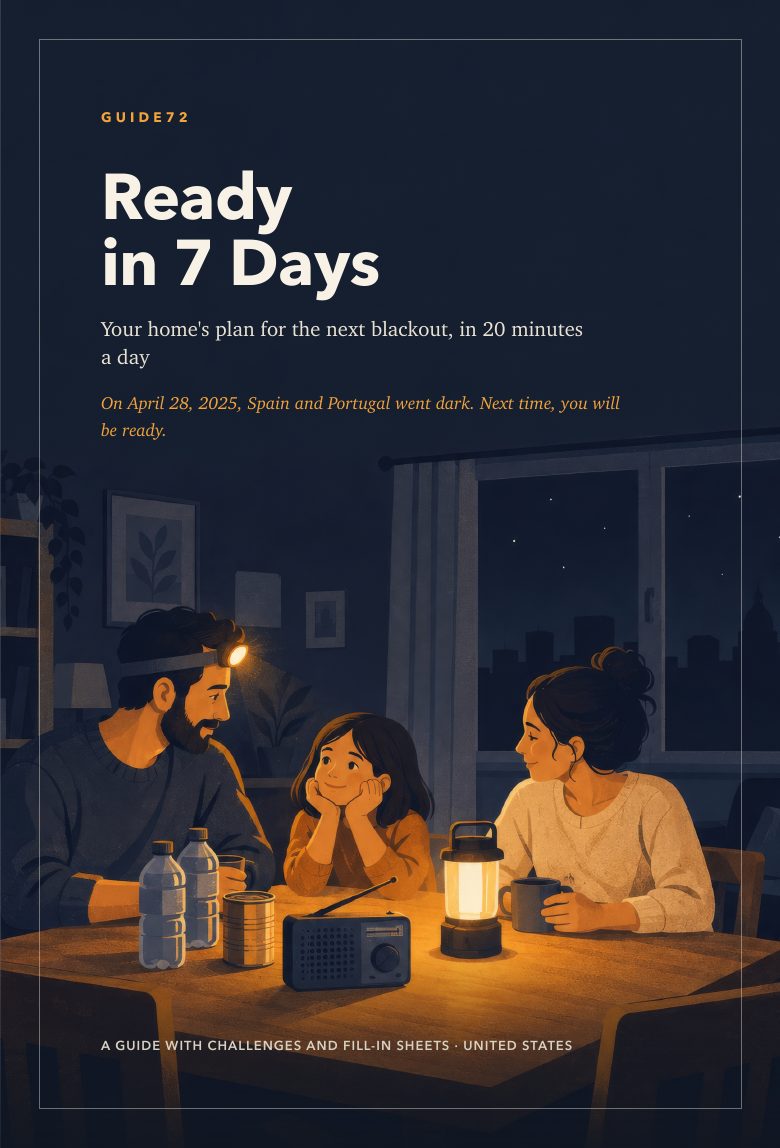
That Monday at 12:33
On Monday, April 28, 2025, at 12:33 p.m., the power went out across mainland Spain and Portugal. Trains stopped in the middle of the track, people were trapped in elevators, traffic lights went dark, ATMs gave no cash and card readers stopped working. By mid-afternoon many phones were dead and cell service came and went. In many homes the lights did not come back until night or the early hours. In February 2021, a winter storm left more than 4.5 million homes and businesses in Texas without power, some for several days. It can happen here.
You do not need a bunker. You need your home to manage on its own for three days, which is what Ready.gov and emergency managers ask for as a starting point.
65% of households in Spain had nothing ready that day, and 42% missed something while it lasted.Spanish Centre for Sociological Research (CIS), snap survey, April 2025
The list is already free. What's missing is doing it.
Governments already publish what to keep at home. The trouble is that a list of forty things gets left for the weekend that never comes. This guide turns it into seven one-day tasks, each with its reason and a table to fill in.
- DAY 1
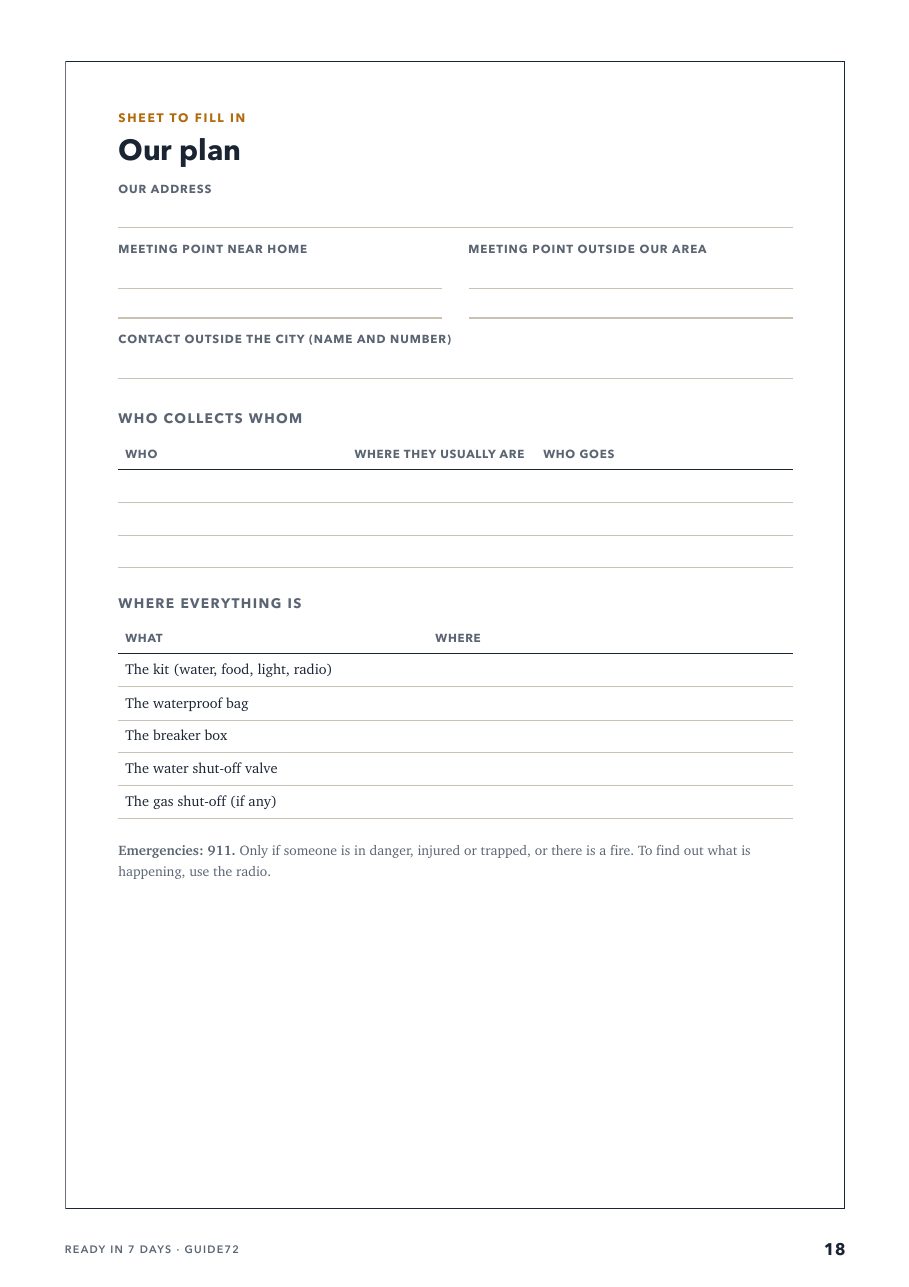
The plan on paper
Meeting points, who collects whom and an outside contact. Phones die; paper doesn't.
- DAY 2
Water
How much your home really needs, where to keep it and how never to waste it.
- DAY 3
Food with no fridge and no cooking
Three days of what you already eat, no cooking needed. And why the camping stove stays outside.
- DAY 4
Light and power
One flashlight per person, batteries that actually fit and not a single candle.
- DAY 5
News without the internet
The radio, your local stations and when to call 911 and when not to.
- DAY 6
Health, papers and cash
Medicines, copies of documents and money in one bag you can grab with one hand.
- DAY 7
The drill
Two hours in the dark, one evening, to find the gaps before they matter.
Print it, fill it in, stick it on the fridge
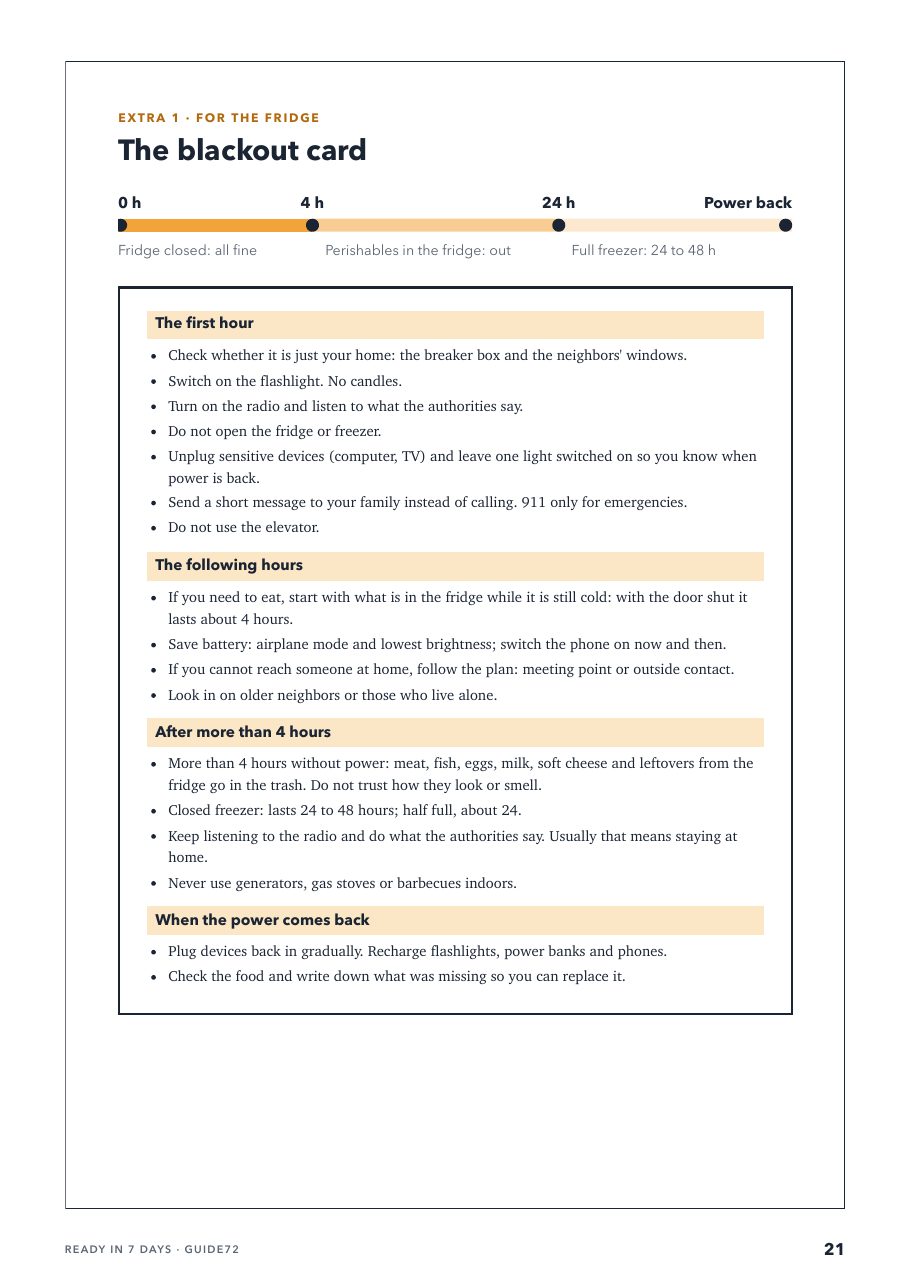
Each day is one page with the same layout. At the end, the household plan sheets and the blackout card, for when your phone is out of battery.
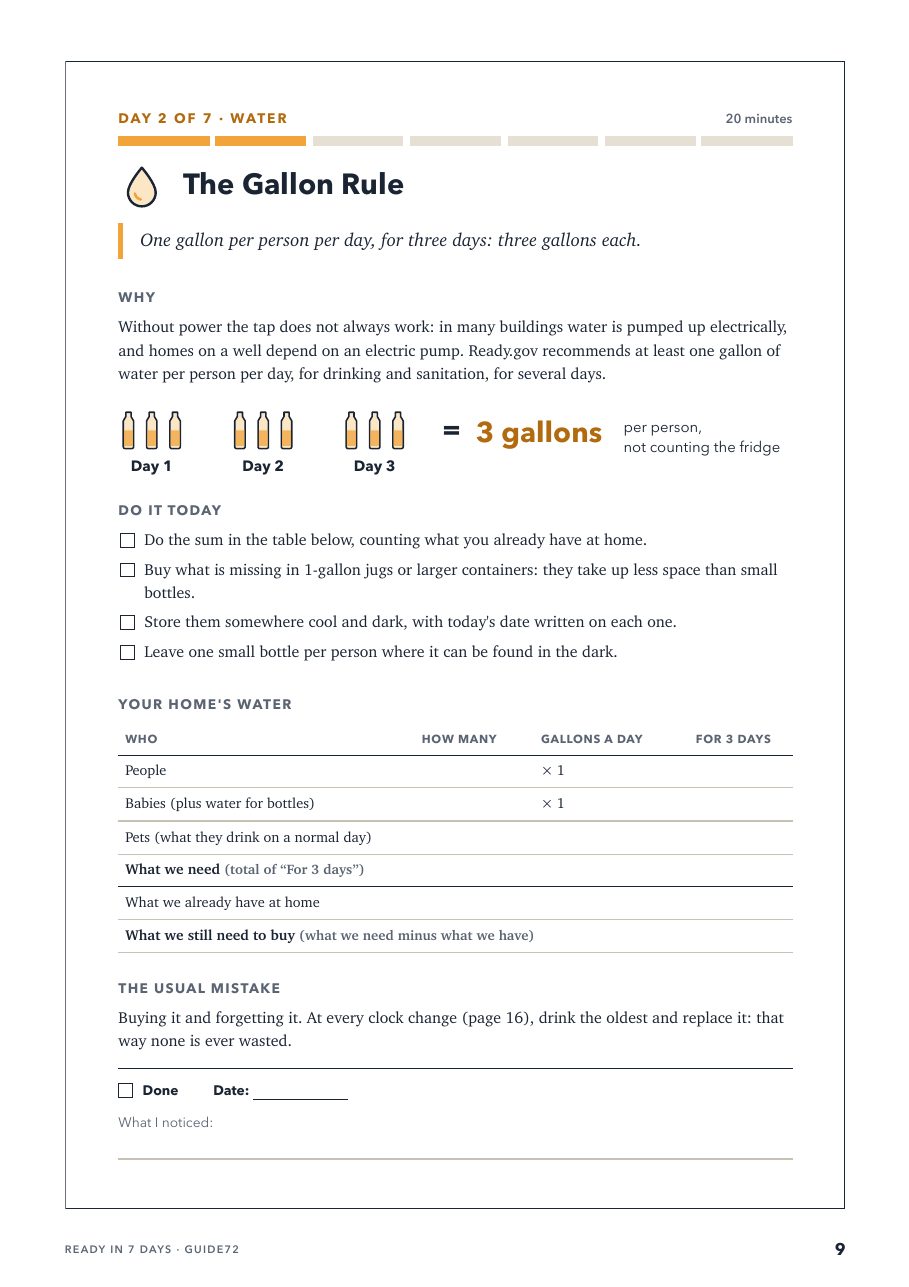
For any home
- High floors, where a power cut means no elevator and sometimes no water.
- Homes with babies, older people or pets.
- Someone who depends on an electrical device.
- People who live alone.
- And if you do not have seven days: the one-hour minimum kit.
What it is not
It does not replace the authorities or 911: if they say otherwise, do what they say. It is not medical advice. And it is not about bunkers or a year of cans, but about three calm days while things outside are fixed.
Every figure comes from a public source, listed at the end of the guide.
Questions
What exactly do I get?
A 26-page PDF: the seven days, the sheets to fill in (household plan, contacts and medication, expiry dates) and four extras: the blackout card, the one-hour minimum kit, shopping on your budget and the grab-and-go bag.
Do I need to buy a lot?
No. You already have a good part of it at home. The guide has three shopping levels for two people (about $50, $100 and $200) and the kit page shows examples of each item.
If the list is free, what am I paying for?
The plan: seven short tasks in order, the tables to fit it to your home, the drill and the rule to keep it up without thinking. A list on its own rarely gets done; a plan does.
Does it work where I live?
There is an edition for each place, with its own emergency number, sources and units: España, Europe (English), United Kingdom, United States, Latinoamérica.
April 28 caught everyone off guard. The next one won't.
Seven sessions of 20 minutes. Start the first one today.
Coming soon $9